18 July 2006

Anna Mikhailovna's Legacy

The funeral tea-party was nearly over - if indeed such an elegant collation of smoked salmon, caviar and canapés, mille-feuilles, passion fruit pavlova and a sculpted ice swan could properly be described as a mere tea-party. Katerina Ivanova leaned against the wall and pondered upon the ceremony and the demeanour of her hostess. She had enjoyed neither.

The silver and black edged invitation had bidden her to attend the “Golden Sunset Crematorium (Private) to join with us in a Secular Ceremony of Farewell to Anna Yanovskaya Smith, widow of John and dearly beloved Mother of Jules (formerly Ulyana)..... Light refreshments in the Hospitality Suite.....R.S.V.P. Mrs Peregrine Cavendish-Brown....”

Katerina took the bus from the tube station to the Godalming Road. She hitched up her long black silk skirt which she had for many years always worn at funerals, and sometimes at weddings too, and strolled back up the road towards the massive wrought iron gates and the wide gravel drive which welcomed the better class of mourner who usually attended Golden Sunset ceremonies. She glared at the Jags and the Mercs and the Porsches in the car park but smiled at the old tandem bedecked with black ribbons padlocked to the railing beside the portico. At least someone, she thought, in this maelstrom of conspicuous wealth and
over-consumption has contrived to get their priorities right.

A flunkey directed her to the Secular Suite. She pushed open the silver and black door and found an empty room awash with purple brocade and black silk, velvet and plush, silver and crystal and preposterously large flowers. In a gloomy corner on a purple bier, almost swamped by a huge wreath of lilies, stood an elaborate black coffin. Secular-ceremonial the room might be designed to be, Katerina mused, but it seemed to her to be awfully like a shrine to bad taste.

Other mourners began to arrive and she retired to a far corner and composed herself for the Ceremony. One word from the Director, a spotty faced young man with pebble glasses and a peculiarly unctuous voice, and she retreated into private consciousness and memory. She and Anna Mikhailovna Yanovskaya had been brought up together in Paris. Anna’s grandfather, banker and astute businessman, had in 1904 moved the family money from St Petersburg to Switzerland and his import-export business and his young family to Paris away from the burgeoning threat of revolution. The Paris business had prospered and the boxes of gold in the Swiss bank had multiplied. Katerina’s own father, the impoverished Count Ivan Gretchaninov, had fled in 1917 also to Paris away from the mayhem that was now loosed in Russia to the shelter and support of the old banker’s son with whom he had gone to school in St Petersburg. The Count and Countess lived happily enough until the Countess’ death in April 1921 two days after the birth of her second child Nikolai Ivanov. The Count never recovered from this loss, never accepted the new baby, took no consolation from the company of his amazingly beautiful three year old daughter Katerina and just after daybreak on a soft July morning in the Bois de Boulogne blew his brains out with the revolver he had brought with him from Russia. His old school friend and his wife opened their hearts and their home to the two orphans and brought them up to be sister and brother to their own one year old daughter Anna.

The young man had stopped talking and music was piped in - sentimental, little children in smocks talking to the bunny rabbits in a woodland glade sort of music. Katerina in her mind’s ear began to sing the sad slow Contakion for the Departed. When, blessedly, the piped music stopped and the chat began again she returned to her memories.

Although Katya was the eldest of the three, it was Anna with her plain happy face and untroubled conscience who mothered and managed the trio, who soothed their hurts and was proud of their many accomplishments. Nikolai was a studious boy with a precocious talent for drawing and painting. Katya was a fine musician with a lovely singing voice which as she matured grew rich and deep. In 1936 the ever perspicacious Mikhail Yanovsky moved his émigré family and household away from Paris to Lausanne where Katya studied at the Conservatoire while Nikolai attended the Ecole des Beaux Arts in Geneva. In 1946 as the concert halls of Europe reopened, Katerina embarked upon a highly successful singing career and Nikolai began to buy and sell fine pictures.

Anna’s son-in-law read a poem of dubious literary merit to which Katerina listened politely, but she returned to memory when yet more regrettable music filled the Ceremony Room. The Yanovskys returned to Paris and Anna met and married John Smith, a young Englishman who had been appointed director of Mikhail’s business interests in London. They bought a big house in Surrey where eventually Anna had a fat and healthy baby girl baptised Ulyana, who grew into a plain and spoiled young woman, married a humourless merchant banker, tended to despise her gentle mother and wholeheatedly hated her mother’s outspoken friend Katerina. They met occasionally in the nursing home into which Anna, after John’s death, had been put as soon as her increasing frailty had become an inconvenience to Ulyana’s important social life. Six months after Anna’s removal Ulyana informed her mother that she had renounced all things Russian and was henceforth to be known as ‘Jules’. Anna, although unhappy, made no protest. Katerina, thoroughly impatient, did so very loudly. Jules shouted that Auntie Katya was an interfering old bat and could leave now. So the invitation to the Ceremony had come as a great surprise.

Suddenly everyone stood up. Pebble Glasses turned to the coffin, waved his hands in the air in what he probably thought was a dignified and meaningful manner and to the sound of muted trumpets the curtains behind the bier parted and the casket slid away into anonymous gloom. Katerina crossed herself three times, and said out loud “Everlasting be your memory, O our sister, who are worthy of blessedness and eternal memory. Come, all you her kindred and friends: now is come the hour of parting. Let us pray to the Lord to bring her to her rest.” Jules interupted her quietly genteel weeping and glared at Katerina. “My friends,” she said, “please do join Peregrine and myself for refreshment. Everyone,” a slight pause, “is most welcome.”

Katerina looked across the Hospitality Room at Jules. Her skirt was too short, her bodice too tight, she was drinking a great deal of champagne and in her high pitched laugh as she circulated amongst her friends was more of tears than of joy. Uneasy for a moment she watched Jules with a small parcel in her hand making her way with tiny bird like steps towards her.

“Aunt Kate. How nice of you to come.”
“Ulyana. How kind of you to invite me. And my name is Katya.”
“And mine Aunt Katya is Jules.”
Katerina heard both the anger and the appeal in the voice. She stretched out her hands, placed them on the young woman’s shoulders and said gently:
“Forgive me. I am old and changes are sometimes alarming. I’m truly pleased you asked me today. I would have been very sad if I hadn’t been able to say good-bye to Anna. Thank you.” She leaned over and kissed Jules lightly on both cheeks and turned to go.
“Wait a moment, please Aunt Katya. Mama asked me to give this to you. She said it had been precious to her, and that when she was gone she hoped it would be precious to you - a sort of treasure that she wanted to share with you.” She held out the small package.
“I’d love to have something of Anna’s. Whatever is it? “
“It’s just an old framed photograph of you and her, when you were girls in Switzerland. Anyhow, she made me promise that I would give it you. Please, do take it.”
“That was so thoughtful of your mother. The older I get the more important the old photos seem to be.” She took the parcel and put it into her deep black bag.
“And now, I think I really must get back to Pimlico. Goodbye my dear. God bless you. I will hold you in my heart.” She clasped the diamond and emerald encrusted hands for a moment, turned, and walked away.

Sometime later Katerina let herself into the apartment in Warwick Gardens which she and Nikolai had shared for many years. She went wearily up the stairs to the drawing room where her brother sat looking out at the gardens. He rose from his chair, taller than his sister but with the same mass of silver hair, strong features and bright mischievous eyes.
“Good evening Countess.” He kissed her hand.
“Good evening Count.” She made him the slightest of curtseys.
“How went your day?”
“In parts, dreadful. The place was dreadful, the Ceremony was dreadful, the music was very dreadful indeed. And I didn’t behave very well.”
“And the party?”
“All right, perhaps. The food was a bit over exuberant. But I made my peace with Ulyana. I left her with a smile and a blessing of a sort.”
“What’s that in your bag?”
“Oh, that. It’s a present - from Anna. A photo Ulyana said.”
“May I see?”
“Of course. But give me a drink first, and then you can open it.”

He filled a glass from the decanter on a side table, brought it over to her, took the parcel and very carefully removed the picture from its padded envelope.
“It’s a photo I took of you and Anna in Lausanne. Two lovely Russian girls, so happy, so full of life. It’s a pretty frame, silver-gilt, but the back is made of wood. That’s why it’s so heavy. Do you mind if I take a closer look at this?”
“Of course not. But do be careful with the photo. Anna said it was a treasure she’d wanted to share with me.”

Nikolai stroked the wood and weighed the picture in his hands. With a slim antique penknife he gently eased out the tiny pins which held the wooden back against the carved frame. Slowly, carefully he removed the panel, glanced at it, and handed it almost reverently to Katerina.


"I think this may be Anna's treasure." he said.
“Oh Kolya,” she said, “it’s an icon. The Virgin Eleousa, the gentle Mother. The colours, and the exquisite patterns on her robes, and the protecting curve of her body around the Christos. It’s beautiful. Is it original?”
“No. The original is much, much bigger. It's in the Tryakov Gallery in Moscow, painted by Simon Ushakov in 1668. This little panel here is just a copy of the original, but it’s exquisitely done and extraordinarily like Ushakov’s. Look. Look how young the virgin is, how her face is rounded and so much more human than in the old icons. It was the influence of Western European naturalistic painting on Ushakov and his School. An old agnostic person like me can empathise much better with this young loving mother in her pretty dress than with the old stylised stiff Virgins who say nothing to me at all. You know.....”

He glanced across at his sister and broke off. With a slight smile around her lips, Katerina had fallen asleep where she sat on the sofa. Very gently he took the icon from her hands and laid it on the table. ‘Stop lecturing and being such an old bore, Kolya.’ he said to himself. ‘But what a blessing Katya, this hidden treasure that Anna Mikhailovna has left to you. God be praised.'

Naomi


24 June 2006

High Flight

Oh, I have slipped the surly bonds of earth
And danced the skies on laughter-silvered wings;
Sunward I’ve climbed and joined the tumbling mirth
Of sun-split clouds - and done a hundred things
You have not dreamed of, wheeled and soared and swung
High in the sunlit silence. Hovering there
I’ve chased the shouting wind along, and flung
My eager craft through footless halls of air;
Up, up the long delirious, burning blue
I’ve topped the wind-swept heights with easy grace,
Where never lark nor even eagle flew;
And while, with silent lifting mind I’ve trod
The high untrespassed sanctity of space,
Put out my hand, and touched the face of God.


John Gillespie Magee 1922-1941


Emily gave me a copy of this poem because, she said, she loved it very much and hoped I would enjoy it too. It reminds me so much of her, especially of the times we sat in the green and blue peace and shelter of Wellington House garden - very happy, gentle and precious times.

Naomi

Oliver's Poem


GREETING

I will not lumber you with love
nor climb on you to measure you for sins
nor wipe you over with foregivenesses
nor kick your shins.

I know your eyes do not see out of mine
nor are your tears the tears I shed
but I don't care,
for I will take your hand and make a place for you,
because you're there.

Not for some complicated ploy
of pity, piety or private greeds
but for an older, simpler joy,
that, nothing wanting, nothing needs,
except to live.

for, as I see you feel the rain and breathe the air,
so just to know the sun that shines on you
shines on me too.
confirms the sunlight,
makes it sure,
tells us we live, are there.
that now will do,

and asks no more.

Oliver Postgate 1979

22 June 2006

Turquoiseism

Words per sese mean absolutely nothing. They are merely groups of aural or written alphabetical symbols arranged together in such a way as to indicate a sound or a combination of sounds which those of us who speak or read a common language tend to invest with more or less the same meaning. I think ‘discrimination’, a word many of us bandy around in a fairly indiscriminate fashion, is a rather difficult and possibly a rather dangerous word, whether written or spoken.

According to the Concise Oxford Dictionary the verb to discriminate in its first meaning is merely ‘to make or see a distinction’, a perfectly neutral action influenced rather often by innocent fancy. I like the colour red, I don’t very much fancy the colour turquoise, so I choose to buy a red jumper and I choose not to buy a turquoise jumper. Unfortunately some tiresome person then comes along and say: “Look at her, she always wears red and always ignores turquoise. She’s discriminating against turquoise. She’s a Turquoiseist!”

Next the politically correct brigade will arrive, write letters of outrage to the Guardian, boycott my tea-parties, hold silent vigils of protest outside my house, found MAT ( Movement Against Tuquoiseism) and generally attempt to ‘persuade’ me into renouncing my antisocial and immoral actions. The MAT might try to justify its campaign by citing the Concise Oxford’s second definition of to discriminate - ‘to make a distinction, esp. unjustly and on the basis of race, colour or sex.’ Its members would, I believe, in this be wholly wrong because they would have omitted from their reasoning the most crucial factor in this equation: my motive for discriminating between red and turquoise jumpers.

None of them ever asked me why I ignored turquoise jumpers. Did it never strike them that I might just, perhaps, simply have noticed that wearing turquoise makes me look like a swept up, faded, wrinkly old leaf which didn’t quite make it to the municipal bonfire? Or has aesthetic discrimination just become a piece of ‘unjust’ discrimination, non-PC? At least in red I still look like an almost vibrant, only slightly wrinkly old plum not yet quite ready for the municipal bonfire. Or maybe I have deeply held spiritual objections to displaying myself in turquoise - for that is the colour of the mystical and malevolent Greater Three-Horned Toad. Perhaps I am severely allergic to one of the constituents of turquoise dyes. One shred of the offending fabric wrapped around my person, and my skin erupts into a dreadfully uncomfortable and hideous purple rash. Are spiritual convictions and medical problems all now to be condemned as non-PC and to be expunged from a properly ordered society?

Ridiculous isn’t it! Like a story board for some warped fairy tale, quite silly really. But not only might this sort of nonsense conceivably happen, something very like it probably will happen. Indeed, maybe it is happening now, only all the sensible people like you and me just haven’t noticed yet.


Naomi

Laughter

LAUGHTER IS A PRECIOUS GIFT

‘He was born with a gift of laughter and a sense that the world was mad. And that was all his patrimony.”
‘Scaramouche’ by Rafael Sabatini

Oliver and I got into terrible trouble once for making a small joke in The Friend about a medical condition from which I suffer. The author of the pompous article which had nudged us into this solecism became quite incandescent with rage that we should dare to laugh about Serious Matters. She wrote to us, and went on at some length listing our manifold iniquities and hoping fervently that we had not done too much Lasting Harm to her Cause. We were not at first exactly amused by this communication - although it did serve as a salutary warning to engage imagination and brain before opening word processing programme - but my bruised psyche was later much soothed by a vision I had of a first Quaker martyr about to be run over by my power chair.

This long ago episode, however, did absolutely nothing to alter my firm conviction that laughter and humour are good for you: they lower the blood pressure, assuage the effects of anger, deflate pomposity and generally restore the equilibrium of the body and of the soul.

Regard these two men -they just happened to be persons of the male gender, nothing sinister in my choice. The first, a very senior cleric and distinguished peace campaigner, I met striding through a meeting hall with what my agnostic and slightly less distinguished peace campaigner partner described as "teeth gritted into a dazzling smile of Christian good humour and loving kindness" spreading unease wherever he looked. The second, an Anglo-Catholic priest I once knew, one memorable Sunday morning in the Sanctuary tripped on his overlong alb up the altar steps, then, burdened with overmuch ecclesiastical iron-mongery and blinded by 'holy smoke', fell down the steps again and finished up on the floor with the Gospel Book clasped to his bosom and his feet inextricably entangled with the base of the Paschal candlestick. He struggled there a second or two in the face of a silent and horrified congregation until he lay back again convulsed with laughter. Everyone laughed, and remembered why they so loved and respected this holy and humble man. Which of these two would you rather sit next to at a dinner party, or entrust with your most intimate problems?

Maybe, as I am reliably informed, there isn't much explicit humour in the Bible, but if we are indeed made spiritually in the image of God, then God himself, herself, itself or themselves must have laughed first and given us an example we should follow. Listen to the chuckle of the beck as it runs down off the high moor or the gentle teasing of a soft wind in the leaves. Look at the sunlight laughing on the tops of the waves or the wide smile of a fenland sky, and be glad.

Naomi

November Morning


NOVEMBER 2004

“...Not the intense moment
Isolated with no before and after,
But a lifetime burning in every moment.”
T S Eliot: ‘East Coker’


One amazing November morning when the sun shone with that sharp, pale golden, early winter light so clear and pure that you can almost hear the sound of an invisible finger stroking crystal, I rode down to the Harbour and parked myself on the quay. A run of gales and very high tides had coincided and the receding waves had left great lagoons abundant with small fish stranded across the top of the beach.

Three Great Black Backed Gulls were fishing. Even two of these, the largest of our native gulls as big as Barnacle Geese, are not often seen together on the South East coast, so the presence of three of them on our beach that morning was pretty remarkable. Accompanying them was a crowd of eager juvenile Herring Gulls as large as their watching, elegantly feathered white and grey parents, but themselves still wearing their speckled baby plumage.

Each time one of the visitors came out of the pool with a fish, some of the juveniles gathered round with shrill calls trying to harry the huge adult into feeding them. Exasperated, the Great Black Back dropped its fish and, just like a goose, raised its beak to the sky and honked a warning. One of the juveniles, quite unintimidated, darted across, seized the abandoned fish and flew off hotly pursued by the Great Black Back. Another Great Black Back emerged from the pool, fish clamped in beak; the remaining juveniles gathered round, and the drama began all over again.

The action was fast, the dialogue simple, and the villain triumphed every time. It was a lovely piece of natural theatre: the backcloth immaculate, the lighting stunning, the air conditioning superb, and the performance was free - a beneficence from a laughing God.

I laugh too all my small miseries forgotten, and thus by some miraculous osmosis an elderly lady in a wheelchair and a few dozen preposterous seagulls are absorbed into a piece of glory. It doesn’t last, that blinding flash of perceptive lightning - that amount of intensity would be too much for humankind to bear for more than a moment; but the enlightening remains, like a bright golden thread woven into the fabric of memory.

Naomi

Brownman & Crippleduck


Ring the bells that still can ring.
Forget your perfect offering.
There is a crack in everything.
That’s how the light gets in.
Leonard Cohen: "Anthem"


Edward Greestone did not really like people. Not that he was aggressive or obsessively withdrawn, but he had an air of apartness about him, of being a man who stood always to one side. He was a pale brown man with a palely sallow skin and pale mousey hair, wearing fawn trousers and a brown jacket. He was neither tall nor short, neither fat nor thin, neither obviously happy, nor obviously sad - altogether a man whom no-one much noticed and whom no-one ever knew. He lived in a modest house with a biscuit-coloured front door on the edge of the city at the end of a short track, muddy or dusty according to the season. Beside the neat front gate was a locked box in which the postman left his few letters and on top of which, in the plastic folder provided, the boy with the red cart left his Free Papers.

He worked from his house, something to do with computers, or so it was said by the gossips in the smart terrace up the road into the city. He was a regular church goer, but not to the little Saxon parish church at the end of the city road. Instead, he walked every Sunday across the wide green acres where once the Roman city had stood and was now a huge public park where swans and moorhens swam in the the lake and children played in the stream while their parents sat in the shade of the ruined walls which were two thousand years old. Then he climbed the long hill to the massive Cathedral which dominated both the cities, old Roman and “new” Saxon. He liked the Cathedral. There he could sit behind a pillar, bothering no-one, unbothered by anyone, and commune with his God in his own individual and solitary way. The clergy, both the local Rector and the Cathedral canons, had tried to visit him pastorally, but none had ever got further than his front doorstep from which after a few moments’ desultory conversation they had been politely but definitively dismissed.

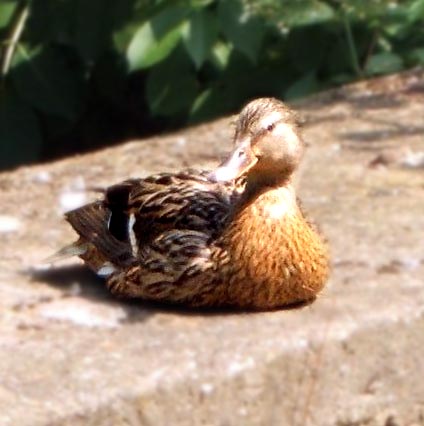
One weekday morning he walked down the hill from the Cathedral - it was Ascension Day and he had been to Choral Matins - and stopped at the bridge over the little stream. He could see a red-headed girl of about eleven or twelve with two quite small boys. ‘She should be at school.’ he thought. One of the boys pulled a small loaf of bread out of the bag the girl was carrying. He held it up over his head and shouted excitedly. Attracted by the shrill calling, a group of Mallard ducks clambered up the low bank and, in a wetly glistening feathery herd, hurried purposefully, as one duck, towards a late breakfast. All of them that is except for the last one to get out of the river who hobbled, one foot shrunken and malformed, slowly along the path behind the rest of the group. The children tore up the bread and offered it to the ravenous group jostling and gobbling around them."Crippleduck. Crippleduck!" they yelled at the straggler. As the lame duck caught up with the rest, the boys broke away and ran down the path, pieces of bread still in hand, laughing and shouting to the ducks "Come on, come on, chase us!" The ducks broke into an untidy slow gallop, leaving their lame cousin yet again way behind and still unfed.

Edward Greestone felt an uncomfortable and wholly unfamiliar anger rising within him. How could these children behave with such unthinking cruelty, how could they run away laughing from this pathetic deformed little creature? How was it that the God whose power and glory and love just twenty minutes ago he had remembered and affirmed could allow such wretchedness, such pain, such casual disregard? He wanted to run after the children and shout at them that he hoped one day they would be left behind, that they would be hungry, that they should know what it felt like to be isolated, an outsider, to be in the world but not a part of the fabric of it. But the children had gone, down the path, through a gap in the hedge, lost in the bright sunshine of the morning.

In his frustration he kicked the bridge, and scuffed his well polished brown shoes. The ducks, finding there were no more crumbs to be had, took themselves back to the river, slid down the bank and into the water. They gathered themselves into formation and swam slowly up stream, whistling softly as contented ducks do, eyes bright, beaks busy snatching and filtering. He watched them as they came towards the bridge - eight mallards, a watery squadron as confident and precise as the flight of Hurricanes he could hear thousands of feet above the city. He counted them again. What had happened to the lame duck, why was she not lagging behind? His anger subsiding, he realised that in the water, in her own environment, in her own world she was not isolated, not an outsider, not a lame duck at all. Whereas himself...

He walked on slowly, thoughtfully, beside the lake, across the soft grass under the old oaks, past the lovely eighteenth century houses in their quiet old gardens and the gentrified Edwardian terrace, up the slight rise to the Saxon Church, then along his own dusty lane. The postman had leaned his bike against the wooden fence and was pushing letters into the locked box. “Good morning,” said Edward Greestone, “it’s a nice day.” The postman, who was very big and very black, was amazed by this greeting from a man who in five years had never acknowledged him with more than a barely polite nod. He swung round, knocked over his bicycle, seized his helmet from his head and held out out his hand. “Brother,” he said, “it is indeed a beautiful day.”

Naomi