14 January 2007

April Song


"... the song was wordless; the singing will never be done."
Siegfried Sassoon

The sound rolled across the surface of the lake like the gradual crescendo of some Russian Choir moving through their cathedral battering the ears of the Almighty with petition and praise. It was Eastertide in the Correze but our choristers were a great company of green pool frogs sitting on the lily pads which spread from one end of the lake to the other. One frog, agitated by a predatory hedge pig snuffling along the far bank, began the chant which was slowly taken up by hundreds of his brethren. Then, as it had begun with a single voice and grown into an immense triumphal shout of “Allelu-ee-a”, it died gradually away from the mighty chorus to a single soft note from somewhere in the middle of the lake.

Only a few yards away from us among the fine old trees of the deserted parkland young red squirrels played. They darted up the huge pines like tongues of crimson flame cauterising the old winter bark and burnishing the new spring growth. Common lizards roamed around and about or lay on small rocks basking in the gentle April sun. Shy creatures by nature, they largely ignored us, their attention concentrated on the abundance of new springtime food and the exigencies of the rapidly approaching mating season. In mid-western France where we were, the trees were already in new leaf, the rough grasses were studded with tiny yellow and blue flowers, the lake shimmered in the sunshine and the ubiquitous wood pigeon chortled happily to itself as it surveyed its newly rich April forest home.

Later in the afternoon with Oliver and his writing safely ensconced in the salon, I took my crutches and poled down into the village. Accompanied by a loud chorus of “Bonjour Madame. Ca va?” I made my way into the Place de l’Eglise. The church of La Roche Canillac is one of the several rather dull churches of the region - a box of unadorned stone rather like a Yorkshire barn, a bell-wall instead of a tower, but with an unlocked door and a quiet interior which said “Come in. You are welcome.”

The incense of the morning Mass lay heavy in the air and the massive Paschal Candle rose high above the sanctuary. On a chair close to the statue of the Virgin I sat down and chatted to the Lady about the great festival of revival we had found at the lake. I was no longer a Christian and had never had any special devotion to Our Lady, but I talk to seagulls, to the moon in the night sky, so why not to Mary the mother of Jesus? Sitting in this small French rural church I perceived myself united with anyone and everyone who celebrated the same miracle of rebirth I had glimpsed that morning. I lit a candle, as a symbol of my hope and of my thanks giving, and I went home singing.

Naomi

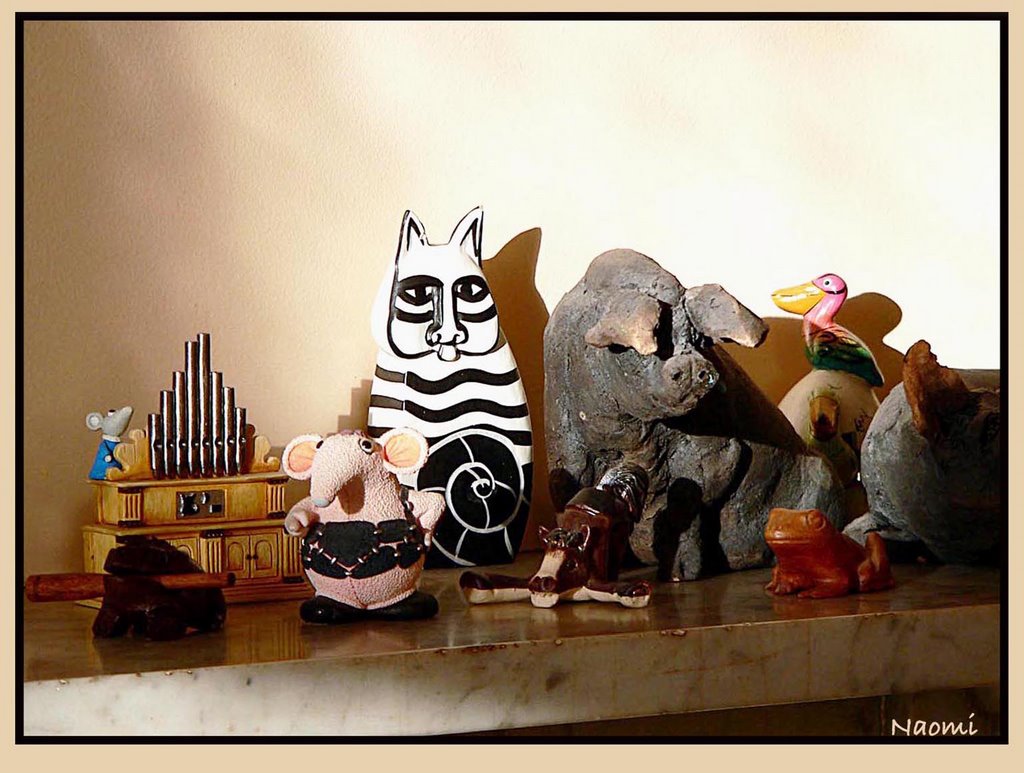
Frogs by Liz

25 December 2006

The Road to Bethany

Who sweeps a room as for thy laws
Makes that and the action fine.
George Herbert


Cynthia and Tom met in Birmingham. She slipped on the newly washed marble floor of the entrance hall in the hospital where they had both recently started work and fell literally into his arms. Three months later they married and when Cynthia presented Tom with the first of their two children she retired to become a full time wife and mother.

Tom, an ambitious but lowly laboratory assistant, studied biochemistry part time and got a first class honours degree. By one of those unlikely but happy coincidences, he presented himself at the University Careers office just as the Professor of Biochemistry phoned to say she had to have a new research assistant in a hurry - the previous assistant having yesterday been inconveniently run over by the Vice-Chancellor’s Deux-Cheveaux. Tom proved to be the perfect man for the job. Devoted to his master, Science, he drank deep at the well of Academe, published a couple of well received monographs and eventually was appointed to head a department of his own.

Through the lean years Cynthia economised and, although the children had everything they needed, she herself made do and mended. Tom bought all the books he wanted, went to all the conferences that interested him and dallied with female post-graduate students. Whenever he found one he particularly fancied, rather like an excited schoolboy taking home his first girlfriend to meet his mother, he would take her home for lunch “to meet Cynthia.” Cynthia would smile, say not a lot and serve the lunch while Tom and the lady indulged in riotous conversation on arcane biochemical matters. Cynthia was widely regarded in the University as awfully nice and very worthy, but just a bit dull and dowdy and boring.

When aged 52 Cynthia died from an aggressive breast cancer all the neighbours came to her funeral, but few of the University wives. Left alone after the wake, an inconsolable Tom hunted through Cynthia’s cupboards and boxes trying to find there something of her to ameliorate his pain. Already half out of his mind with grief, he found only old clothes painstakingly repaired, meticulously kept housekeeping accounts, the few postcards he had sent her. Guilt descended on him, an all enveloping blanket of self disgust and absolute despair. He surveyed the ashes of his important achievments and the spent glory of his important thoughts and he wept.

Cynthia had not looked for martyrdom, Tom was not a monster, but now he rapidly descended into a melancholic alcoholism - a deserted and disillusioned wailing Mary. His quiet Martha who had loved both God and her neighbour lay cold in her grave, but warm and vital in the hearts of her children and everyone whose life she had touched and served. Whose was the good or the better part? Not Tom’s, that’s for sure. Long ago Jesus had nominated Mary, but I always did suspect that on that occasion he got it wrong.

Naomi

10 December 2006

04 October 2006

Exodus


“He was just some Joseph looking for a manger”
Leonard Cohen


Towards the end of winter a small colony of blind Driver Ants made its preparations for escape. The corporate intelligence of 250,000 ants had decided to move away from their dying mountain forest and march towards the coast. On the beach just above the tide line they discovered a large hollow log well suited to be both a nest and a vessel. Having established a temporary home in the coarse grasses behind the beach, phalanxes a thousand strong gathered and moved quantities of food into their new log home. Large male ants were captured by the workers who tore off their wings and accompanied their hymenal procession back to the grassy nest and their Queen. The colony was ready. Long lines of soldiers guarded the Queen and her eggs as they were escorted into the log where the rest of the colony was already installed and the entrance was sealed. That evening the tide was extraordinarily high and the log was swept south out to sea.

In the early Spring a flock of Cape Crows flew south. In spite of fifty million years of imprinted instinct and custom, they abandoned their parched, sweltering homeland and island-hopped across the raging seas until a remnant of the original flock, wind-hurtled, bedraggled and hungry, found an island where the grass was green, the spring water was sweet and flowers still grew. There the Crows found insects, small reptiles and mammals and a flock of inoffensive Yellow Birds. The Crows had arrived in the Promised Land.

By the time the log with its colony of ants was washed up on Yellow Bird Island the Crows were running out of food. The flock had stripped the scrubby bushes, eaten every visible insect, consumed any tiny creature who had not taken refuge underground, killed and devoured all the small Yellow Birds. No longer acting as a coherent group, they began to turn on their weaklings. First they throttled and ate the sick and the old, then the young fledglings. Now lurking solitary in undergrowth and in dark rock fissures they stalked and killed each other. Those who escaped cannibalism fell starving out of the sky and their bodies began to rot.

The Ants unsealed the log and organised themselves. They gathered up every tiny morsel of food the crows had not found, they smelled out the underground fugitives, killed and carried some of them back, in many pieces, to the nest. They feasted on the remains of the crows. Everything they could scavenge, everything they took they shared, but for now left alone the younger animals and the microscopic insect eggs the Crows had failed to see. Yellow Bird Island was theirs and the colony perhaps had a future.

When the sun turns blood red, when our piece of the planet burns up, when the ocean rises, the sea boils and the great flood comes, when we fly from the destruction of our homelands, whose example shall we follow - that of the Crows or of the Ants?

Naomi

21 September 2006

Bad Soldiers

My speculative and philosophical powers are out of a rather large Syrian hamster, by a particularly puny armadillo. Both these creatures are solitary, short sighted and small brained. Neither has much capacity for anticipating danger - hamsters regularly fall off tables and chairs with no visible expression of concern, and the nine banded armadillo leaps straight up into the air to avoid danger, without first looking to see if there is anything in its way. This careless manoeuvre has resulted in the untimely demise of many armadillos who have unthinkingly head butted the undersides of passing cars. My unthinking tends to work in much the same way.

In 1957 I was given a copy of “A Year of Grace” compiled by Victor Gollancz “to express a mood about God and man” - an anthology now out of print but still to be had in libraries and second-hand bookshops. It’s good brain food and I recommend it. Gollancz drew from more than 160 different sources ranging from the Upanishads to the Yorkshire Evening Post, and from Marcus Aurelius to Albert Schweitzer. I remember in the long aftermath of the sometimes bitter Peace of 1945 being much moved and provoked into thought by a report he reprinted from his own monthly, ‘Left News’. In the midst of the current maelstrom of the fanaticism, hatred and hysteria stemming from the Middle East, it resonates just as powerfully now as it did sixty two years ago.

‘November, 1944 .....an extract from a letter received from an Austrian Jew now in the British Pioneer Corps in the B.L.A. He is attached to a hospital receiving German wounded. He had been for nine months in the concentration camps of Dachau: he had been hung by the wrists to a tree and had nearly died of gangrene, Jews at that time not being allowed medical attention in concentration camps......

‘“This is being written in the solitude of a ward in which I am guarding wrecked members of the Herrenvolk. It is so strange a situation that I can hardly describe what I am feeling. Loneliness is perhaps the only word for it. These are men who set out to conquer the world, and they and their kind have done unspeakable things to me and my kind, and I am supposed to hate them with all my strength, and would be right to do so according to the recognised standards of human behaviour. But I cannot hate, or is it that in the face of suffering hatred is silent? So it happens that the guard is turned into a nurse, and if a man, from losing too much blood, goes out of his mind and stammers incoherently, I have to talk him to sleep again. And it sometimes happens that men try to hold my hand when I have helped them.....

“What shall I make of that? I can only draw one conclusion, which is that I am a terribly bad soldier and I am somehow glad about it.”’

Let us thank God for bad soldiers.

Naomi Linnell

06 August 2006

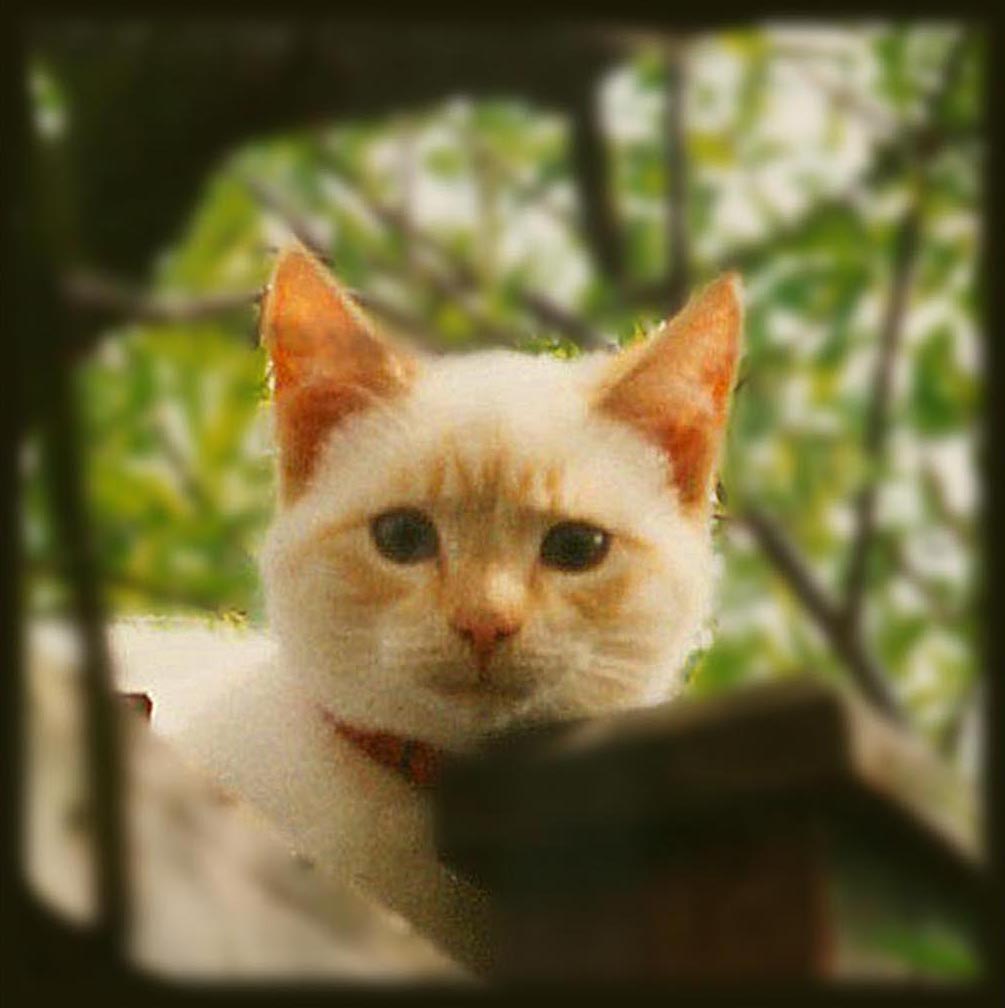
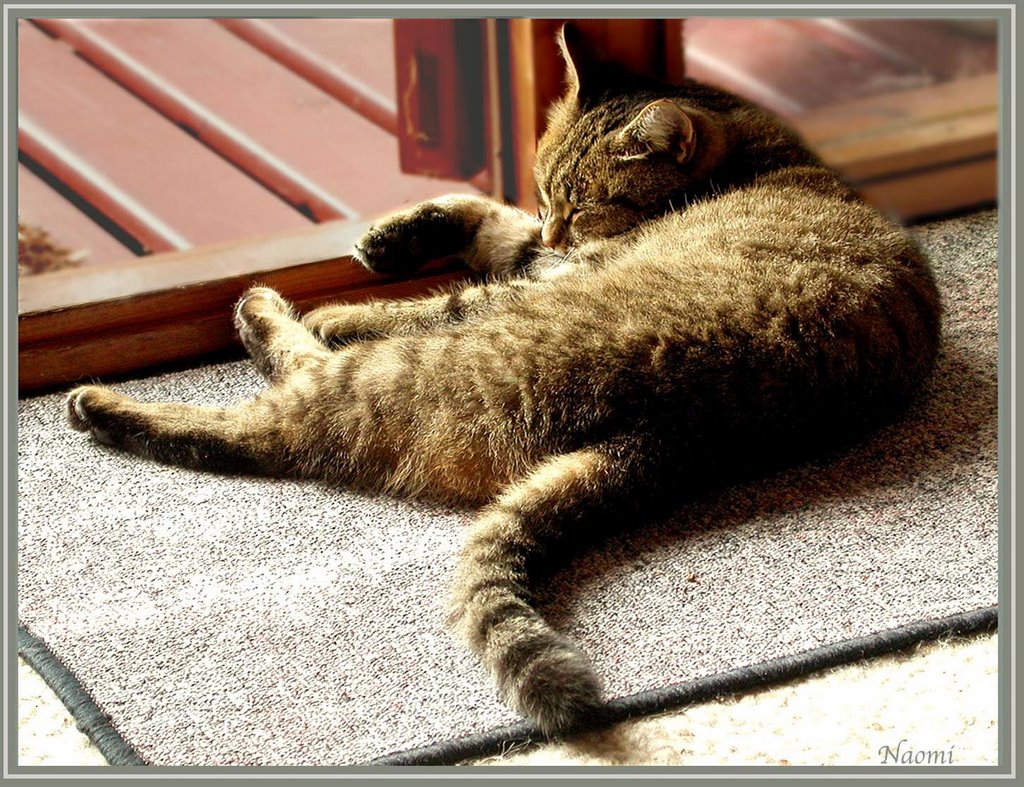
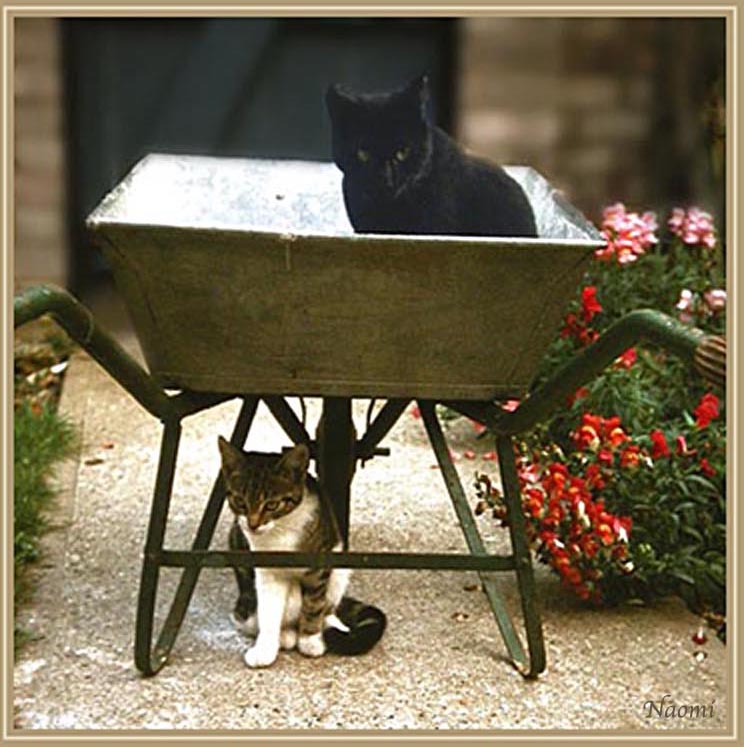
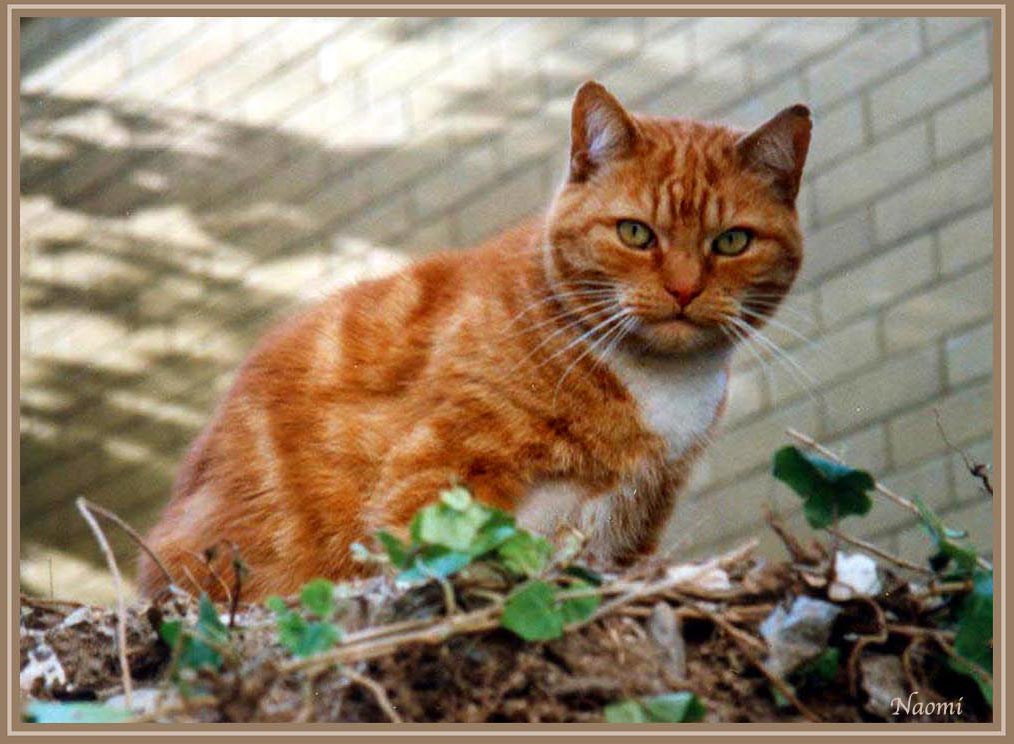
Cat Friends


BAGPUSS
in the Garden


NEWBURY CATS


KINGSDOWN CAT


FRED & GEORGE
in Canterbury


THE BROADSTAIRS BRUISER


EGBERT & FRIENDS


DAISY
in an Oxfordshire Garden


GRACE
in
a Bag


photo by Florence


18 July 2006

Anna Mikhailovna's Legacy

The funeral tea-party was nearly over - if indeed such an elegant collation of smoked salmon, caviar and canapés, mille-feuilles, passion fruit pavlova and a sculpted ice swan could properly be described as a mere tea-party. Katerina Ivanova leaned against the wall and pondered upon the ceremony and the demeanour of her hostess. She had enjoyed neither.

The silver and black edged invitation had bidden her to attend the “Golden Sunset Crematorium (Private) to join with us in a Secular Ceremony of Farewell to Anna Yanovskaya Smith, widow of John and dearly beloved Mother of Jules (formerly Ulyana)..... Light refreshments in the Hospitality Suite.....R.S.V.P. Mrs Peregrine Cavendish-Brown....”

Katerina took the bus from the tube station to the Godalming Road. She hitched up her long black silk skirt which she had for many years always worn at funerals, and sometimes at weddings too, and strolled back up the road towards the massive wrought iron gates and the wide gravel drive which welcomed the better class of mourner who usually attended Golden Sunset ceremonies. She glared at the Jags and the Mercs and the Porsches in the car park but smiled at the old tandem bedecked with black ribbons padlocked to the railing beside the portico. At least someone, she thought, in this maelstrom of conspicuous wealth and
over-consumption has contrived to get their priorities right.

A flunkey directed her to the Secular Suite. She pushed open the silver and black door and found an empty room awash with purple brocade and black silk, velvet and plush, silver and crystal and preposterously large flowers. In a gloomy corner on a purple bier, almost swamped by a huge wreath of lilies, stood an elaborate black coffin. Secular-ceremonial the room might be designed to be, Katerina mused, but it seemed to her to be awfully like a shrine to bad taste.

Other mourners began to arrive and she retired to a far corner and composed herself for the Ceremony. One word from the Director, a spotty faced young man with pebble glasses and a peculiarly unctuous voice, and she retreated into private consciousness and memory. She and Anna Mikhailovna Yanovskaya had been brought up together in Paris. Anna’s grandfather, banker and astute businessman, had in 1904 moved the family money from St Petersburg to Switzerland and his import-export business and his young family to Paris away from the burgeoning threat of revolution. The Paris business had prospered and the boxes of gold in the Swiss bank had multiplied. Katerina’s own father, the impoverished Count Ivan Gretchaninov, had fled in 1917 also to Paris away from the mayhem that was now loosed in Russia to the shelter and support of the old banker’s son with whom he had gone to school in St Petersburg. The Count and Countess lived happily enough until the Countess’ death in April 1921 two days after the birth of her second child Nikolai Ivanov. The Count never recovered from this loss, never accepted the new baby, took no consolation from the company of his amazingly beautiful three year old daughter Katerina and just after daybreak on a soft July morning in the Bois de Boulogne blew his brains out with the revolver he had brought with him from Russia. His old school friend and his wife opened their hearts and their home to the two orphans and brought them up to be sister and brother to their own one year old daughter Anna.

The young man had stopped talking and music was piped in - sentimental, little children in smocks talking to the bunny rabbits in a woodland glade sort of music. Katerina in her mind’s ear began to sing the sad slow Contakion for the Departed. When, blessedly, the piped music stopped and the chat began again she returned to her memories.

Although Katya was the eldest of the three, it was Anna with her plain happy face and untroubled conscience who mothered and managed the trio, who soothed their hurts and was proud of their many accomplishments. Nikolai was a studious boy with a precocious talent for drawing and painting. Katya was a fine musician with a lovely singing voice which as she matured grew rich and deep. In 1936 the ever perspicacious Mikhail Yanovsky moved his émigré family and household away from Paris to Lausanne where Katya studied at the Conservatoire while Nikolai attended the Ecole des Beaux Arts in Geneva. In 1946 as the concert halls of Europe reopened, Katerina embarked upon a highly successful singing career and Nikolai began to buy and sell fine pictures.

Anna’s son-in-law read a poem of dubious literary merit to which Katerina listened politely, but she returned to memory when yet more regrettable music filled the Ceremony Room. The Yanovskys returned to Paris and Anna met and married John Smith, a young Englishman who had been appointed director of Mikhail’s business interests in London. They bought a big house in Surrey where eventually Anna had a fat and healthy baby girl baptised Ulyana, who grew into a plain and spoiled young woman, married a humourless merchant banker, tended to despise her gentle mother and wholeheatedly hated her mother’s outspoken friend Katerina. They met occasionally in the nursing home into which Anna, after John’s death, had been put as soon as her increasing frailty had become an inconvenience to Ulyana’s important social life. Six months after Anna’s removal Ulyana informed her mother that she had renounced all things Russian and was henceforth to be known as ‘Jules’. Anna, although unhappy, made no protest. Katerina, thoroughly impatient, did so very loudly. Jules shouted that Auntie Katya was an interfering old bat and could leave now. So the invitation to the Ceremony had come as a great surprise.

Suddenly everyone stood up. Pebble Glasses turned to the coffin, waved his hands in the air in what he probably thought was a dignified and meaningful manner and to the sound of muted trumpets the curtains behind the bier parted and the casket slid away into anonymous gloom. Katerina crossed herself three times, and said out loud “Everlasting be your memory, O our sister, who are worthy of blessedness and eternal memory. Come, all you her kindred and friends: now is come the hour of parting. Let us pray to the Lord to bring her to her rest.” Jules interupted her quietly genteel weeping and glared at Katerina. “My friends,” she said, “please do join Peregrine and myself for refreshment. Everyone,” a slight pause, “is most welcome.”

Katerina looked across the Hospitality Room at Jules. Her skirt was too short, her bodice too tight, she was drinking a great deal of champagne and in her high pitched laugh as she circulated amongst her friends was more of tears than of joy. Uneasy for a moment she watched Jules with a small parcel in her hand making her way with tiny bird like steps towards her.

“Aunt Kate. How nice of you to come.”
“Ulyana. How kind of you to invite me. And my name is Katya.”
“And mine Aunt Katya is Jules.”
Katerina heard both the anger and the appeal in the voice. She stretched out her hands, placed them on the young woman’s shoulders and said gently:
“Forgive me. I am old and changes are sometimes alarming. I’m truly pleased you asked me today. I would have been very sad if I hadn’t been able to say good-bye to Anna. Thank you.” She leaned over and kissed Jules lightly on both cheeks and turned to go.
“Wait a moment, please Aunt Katya. Mama asked me to give this to you. She said it had been precious to her, and that when she was gone she hoped it would be precious to you - a sort of treasure that she wanted to share with you.” She held out the small package.
“I’d love to have something of Anna’s. Whatever is it? “
“It’s just an old framed photograph of you and her, when you were girls in Switzerland. Anyhow, she made me promise that I would give it you. Please, do take it.”
“That was so thoughtful of your mother. The older I get the more important the old photos seem to be.” She took the parcel and put it into her deep black bag.
“And now, I think I really must get back to Pimlico. Goodbye my dear. God bless you. I will hold you in my heart.” She clasped the diamond and emerald encrusted hands for a moment, turned, and walked away.

Sometime later Katerina let herself into the apartment in Warwick Gardens which she and Nikolai had shared for many years. She went wearily up the stairs to the drawing room where her brother sat looking out at the gardens. He rose from his chair, taller than his sister but with the same mass of silver hair, strong features and bright mischievous eyes.
“Good evening Countess.” He kissed her hand.
“Good evening Count.” She made him the slightest of curtseys.
“How went your day?”
“In parts, dreadful. The place was dreadful, the Ceremony was dreadful, the music was very dreadful indeed. And I didn’t behave very well.”
“And the party?”
“All right, perhaps. The food was a bit over exuberant. But I made my peace with Ulyana. I left her with a smile and a blessing of a sort.”
“What’s that in your bag?”
“Oh, that. It’s a present - from Anna. A photo Ulyana said.”
“May I see?”
“Of course. But give me a drink first, and then you can open it.”

He filled a glass from the decanter on a side table, brought it over to her, took the parcel and very carefully removed the picture from its padded envelope.
“It’s a photo I took of you and Anna in Lausanne. Two lovely Russian girls, so happy, so full of life. It’s a pretty frame, silver-gilt, but the back is made of wood. That’s why it’s so heavy. Do you mind if I take a closer look at this?”
“Of course not. But do be careful with the photo. Anna said it was a treasure she’d wanted to share with me.”

Nikolai stroked the wood and weighed the picture in his hands. With a slim antique penknife he gently eased out the tiny pins which held the wooden back against the carved frame. Slowly, carefully he removed the panel, glanced at it, and handed it almost reverently to Katerina.


"I think this may be Anna's treasure." he said.
“Oh Kolya,” she said, “it’s an icon. The Virgin Eleousa, the gentle Mother. The colours, and the exquisite patterns on her robes, and the protecting curve of her body around the Christos. It’s beautiful. Is it original?”
“No. The original is much, much bigger. It's in the Tryakov Gallery in Moscow, painted by Simon Ushakov in 1668. This little panel here is just a copy of the original, but it’s exquisitely done and extraordinarily like Ushakov’s. Look. Look how young the virgin is, how her face is rounded and so much more human than in the old icons. It was the influence of Western European naturalistic painting on Ushakov and his School. An old agnostic person like me can empathise much better with this young loving mother in her pretty dress than with the old stylised stiff Virgins who say nothing to me at all. You know.....”

He glanced across at his sister and broke off. With a slight smile around her lips, Katerina had fallen asleep where she sat on the sofa. Very gently he took the icon from her hands and laid it on the table. ‘Stop lecturing and being such an old bore, Kolya.’ he said to himself. ‘But what a blessing Katya, this hidden treasure that Anna Mikhailovna has left to you. God be praised.'

Naomi